
Consistency, rugby and horny gods
At first, I had planned that the first post of this blog would be about why I chose the name Serafiloc for this webpage and the origins of its slogan. But two weeks ago, was the finals of the Six Nations and the Rugby Europe Championship (in which the Spanish national team ended in third place). Also, it was 4 months ago when I saw a rugby match in a stadium for the first place, Fiji vs Spain. I have to mention as well that the success that the series A Knight of the Seven Kingdoms is having is one of the reasons, since (in case you didn't know), the actor who plays Ser Duncan, Peter Claffey, played rugby on Ireland's U20 team. Then the situation changed quite a bit, well, not to say a lot, and I decided to make this first post about two of my passions: rugby and localization. All right then, let’s try.
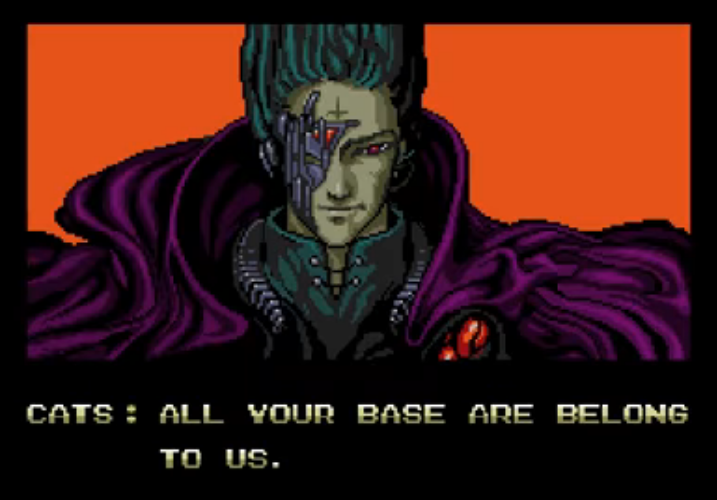
I think Cats meant here “All your try are belong to us”.
Probably, some of you will say (or write) that those two things have nothing in common, apart from when a rugby video game comes out. However, you'd be wrong because they share more things in common than you think localization-wise.
Because not only in localization you must keep an eye on translating and writing texts that sound natural and maintain a consistent terminology, you also have to do the same in sports (and well, and in everything else, if possible). Okay, so let's start with the name of the sport itself. Did you know that in Spain you can call it rugby or rugbi? But if we write rugby in Spanish, we must use italics since it is a foreign word, while rugbi does not need them as it is a word adapted to the Spanish language and accepted by the RAE (the organization that regulates the Spanish language). But to be honest, I have never seen the word rugbi except for when I was researching for this post and proofreading it. But hey, I am not a native speaker of English, so please do not give me a red card if I made a lot of mistakes!
Anyway, back to rugby, let's assume we need to localize a video game about the sport into Spanish, and we use both rugbi and rugby. What would happen then? Well, in this case, we would be creating a consistency error, although not a big one for Spanish speakers, because it kinda looks the same and most people would think it's a typo and not a terminology oopsie. However, if we start using different terms for the same move or players’ positions, we would be sending the translation's consistency to the sin-bin and creating a huge headache for new fans of the sport, and not precisely because they got hit in the head by the rugby ball after a kicker tried to make a conversion after a try.
By the way, did you know that in Spain we call a scrum a melé? Maybe some people who are huge fans of the sport knew this fact. Still, when translating the game into Spanish, we use both scrum and melé; the new fans will get all mixed up and think that each term is a different move or action.
And that's where the term base, TB, or terminology base comes to the rescue! For example, in MemoQ, the CAT tool (no, it's not a cat, and definitely not related to the Cats ) that I use most, the terminology base appears like in a table, next to the translation panel.

Obviously, in most projects you’d see more terms, but I don't want to draw the attention of the NDA police.
Following the example of the term above, if we write libro de hechizos instead of grimorio in our Spanish translation, MemoQ will give an error with a thunder icon next to the segment we are translating. If we switch back to rugby, if we establish rugby as the term for the name of the sport in our project, it will give us the same error if we use rugbi anywhere in our translation. Therefore, this QA check tool in MemoQ is essential in order to keep the terminology consistent everywhere in our translation projects.
On top of that, it is also crucial that we follow the established terminology by previous entries in the series, works in which the game is based, or, in the case of this post, rugby's terms or the ones used by their associations. Talking about consistency, I should mention that in rugby, each player's number shows the position they play. A rare case of "numerical consistency" in sports. However, I find it kind of hilarious that the Spanish (Spain) page of World Rugby does not show the terms used in Spain, like using scrum instead of melé or other terms that are a word-by-word translation from English. Therefore, in this post, we will use the terminology used by the Royal Spanish Rugby Association.
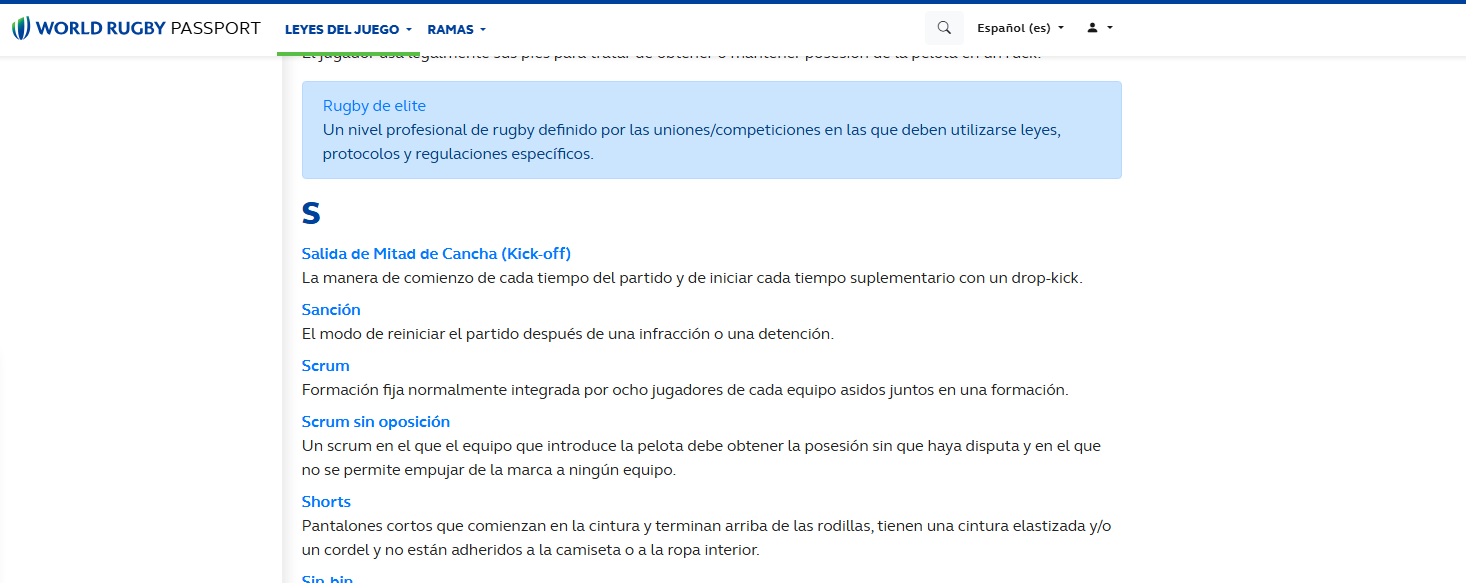
As you can see here, they use scrum instead of melé. But, hey, thanks for explaining what shorts are!
Meaning that we can not come up with new terms or names, or use them in whatever way we want. We must follow, whether we like it or not, the terms established by the client or the reasons mentioned above, unless they say otherwise, such as when in the Spanish (Spain) translation of Pokémon games the name of the attack Counter (Contador) was changed to Contraataque or the case when in the famous 90s anime, Slayers, the legendary spell of Lina Inverse, the Dragon Slave (Matadragones) was translated into Spanish as "Slave Drug" (Droga de esclavos) due to a problem with the katakana writing of said spell.
But the consistency does not apply only to the terms used; it also applies to the format used in the whole translation project. For example, in Spanish, we need to write the names of creation works in italics or between Latin (or angled) quotation marks. So, it would not look good at all if we use italics in some parts and quotation marks in others. That said, sometimes the game's code will not let us use Latin quotation marks or italics, and we will have to use the English quotation marks.
But let's go back to the beastly game played by gentlemen. Let's have a look (or a read) at some Spanish established terms of this sport and its origin:
Sin-bin: Well, it was obvious that this term was going to appear due to the puns I made with it previously. A sin-bin is basically the place where a player who has received a yellow card goes to "think about their sin" (with sin here being foul play) during the 10 minutes that the yellow card penalization lasts. And as much as I would love to translate it into Spanish as silla/banco de pensar because it is the name that we used to give to the place where teachers sent you in pre-school to "think (pensar)" about whatever mischief you caused. Sadly, I can't because the term used in Spain is also sin-bin. And if I did use banco or silla de pensar I would be sending the terminology to the sin-bin and making fans of the sport think, "did this person not research before translating?"
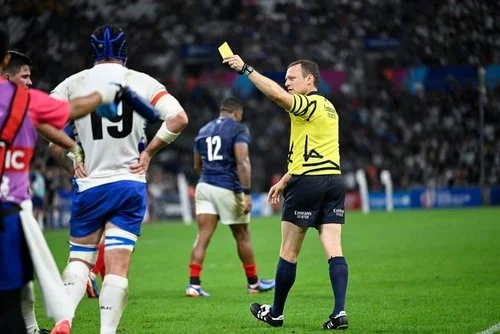
Well, to the sin-bin you go for not researching!
Avant: No, it is not the Spanish trains with the same name. This is another case of the use of foreign words in rugby, just that in this case it does not come from English but from French. And basically, this term is used when a player passes the ball forward (willingly or by accident). Although, in recent years, some fans or commentators are using more the expression pase adelantado or simply adelantado (which is sort of the meaning of avant in French). But in spite of that, if we use the term avant, we need to keep in mind that, as a foreign word, it needs to be in italics if used in our Spanish translation, if the code allows it, of course.
Talonador: This is the Spanish term for the hooker (no, naughty-naughty people, not THAT kind of hooker). It is the player with the number 2 on its back, and in English, the name comes because it is the player that "hooks" with the two props during a scrum and also the ball with its legs. And that last one is the origin for the Spanish term, because they use their heels (talón [singular] or talones [plural]) to move the ball, so basically the Spanish term talonador would be something akin to "heeler" in English.
Transformación: Spanish term for conversion that literally means transformation or to transform. And no, Ditto is not suddenly playing rugby in Spain. The origin of this term is that you "transform" the score after a try if the kicker successfully makes the ball pass between the in-goal, therefore transforming (transformando) the scoring of the try.
Spanish kicker during the Fiyi vs Spain match. Yes, it’s blurry as hell, but the person that recorded it is a translator and not a professional photographer. “Serafiphoto, be not blurry” coming soon?.
Melé: We have talked about this Spanish term already, but it is basically how we call the scrum. And a term that has been transformed (ba dum tss) from French (mêlée) into Spanish to match our phonetics and writing. It is one of the most notorious moves in rugby that... Anyhow, this is the English version of this post, and rugby is more well-known in English-speaking countries and outside of Spain, so I don't need to explain what it is (unlike in the Spanish version of this post).
Zaguero: Or fullback in English. I have added this term because I love that it comes from an idiom, ir a la zaga which literally means to be behind or in the rear.
Puntapié/Golpe de castigo: Literally "punishment kick" or "punishment hit" and no, they are not doing sadomasochistic stuff in the field (footballers might say so), they refer to penalty and free kicks. Apart from doing this horrible pun on the post, I added those two terms to remark the importance of researching while translating, since they are both penalties, and it would be easy to use the wrong term in our Spanish translation and get a "penalty proofreading" of our mistranslation.
Los Quince de...: This is the way we call the national teams of rugby union (not rugby 7) in Spain. For example, our national team is los Quince del León (the Lions' fifteen), Ireland is the Shamrocks' fifteen, Scotland is the Thistle's fifteen, and so on.
Lastly, after the third half and away from the field, I will tell you about a recent situation I had while working on a localization project based on a comic-book series. So, as you can (or should have) seen on my webpage, I am a mythology fan. We had a term dios cornudo, which, yes, can mean "horned god" but also a cornudo in Spanish, which means someone who has been cheated on. But I knew they were referencing the deity Cernunnos, so I wanted to use the term dios astado, which is the term most used in Celtic mythology books and Wiccan sources. And also to avoid the comic situation, that some Spanish speakers would think that the poor god has a very horny partner (yeah, the Pun fest continues), who kept cheating on him, and I almost ruined the consistency of the project by wanting to use dios astado were it not for, Sara Aguirre, one of my colleagues working with me on this project that contacted the translator of the comics that the videogame was based on and confirmed that the established term was dios cornudo and it was the one we had to use, even it made my poor heart suffer by not using the mythology term.
In any case, I hope that this post made you understand how vital terminology is for a proper translation and why we should try to (5 points for anyone who gets this pun) and keep it consistent in the whole project to not confuse the target audience. Or to teach you a bit of the great sport that is rugby. As well as how much AI can really mess things up if they have to translate words like "hooker" or "sin-bin" into Spanish. Or ensayo de castigo into English, because yes, I have seen it already translated literally as "trial of punishment" and while yes, there are probably a lot of lawyers or law students playing the sport, I think it is a bit extreme to send them to a trial because they stopped the rival team from scoring a try due to a foul play.
And if not, hey, maybe this post will help me translate rugby-related content. But in the meantime, I can only wish that in an alternate universe I could have played this magnificent sport since childhood, or have even a team nearby and congratulate los Leones for their bronze in the Rugby Europe Championship.
List of references:
Cain, N. y Growden, G. (2011). Rugby Union for Dummies 3rd Edition. John Wiley & Sons.
FundéuRAE. (2020). Tokio: rugby: https://www.fundeu.es/recomendacion/juegos-olimpicos-tokio-rugby/.
Noguera González, J. (2023, 8 de septiembre) Diario AS, Glosario de términos para seguir el mundial de rugby 2023, [online]: https://as.com/masdeporte/polideportivo/glosario-de-terminos-para-seguir-el-mundial-de-rugby-2023-n/.
Movistar + Vamos, (2026). Únete a la Melé: Broadcasts of the Six Nations matches.
Radio Televisión Española, (2025-2026). Broadcasts of the Spanish national team matches.
Real Academia Española y Asociación de Academias de la Lengua Española: Diccionario panhispánico de dudas [online]. Consulta: 23/03/2026: https://www.rae.es/dpd/rugbi, 2.ª edición.
Real Academia Española y Asociación de Academias de la Lengua Española: Diccionario de la lengua española [online]. Consulta: 16/03/2026 https://dle.rae.es/mel%C3%A9.
Real Federación Española de Rugby (FERugby). 10/07/2023: Reglamento de partidos y competiciones [online]: https://ferugby.es/Descargar/1173/legislacion-fer/68974/03-reglamento-de-partidos-y-competiciones-ferugby.pdf.
Real Federación Española de Rugby (FERugby). 10/2025: Rugby para todos [online]: https://ferugby.es/wp-content/uploads/2025/12/Circular-18-01.-Anexo-1.-Reglamento-Rugby-Para-Todos.pdf.
World Rugby, Leyes del juego: definiciones [online]. Consulted on: 16/03/2026: https://passport.world.rugby/es/leyes-del-juego/definiciones/.
